Wednesday, 27 November 2013

Monday, 25 November 2013
Regional Identity

It refers to the act of identifying with a specific geographic region of a nation. Each region has it's own culture and eccentricities, blessings and challenges.
Where are you and your family from?
I was born in Leicester and my parents were both born in Coventry. Their parents are from Wales and Ireland. 'Callanan' is an Irish surname.
Do you have an accent or use dialect words for things? ( e.g. I call an alleyway between two houses a jitty')
I wouldn't say I have an accent, but obviously people from other regions would say I have.
In my house it's called a 'batch', not a 'cob' or a 'bread roll'
Do you think you can tell where people come from by their accent/clothing/food habits/how they spend money/etc ?
No, it all depends on the individual. There are stereotypes for how people from different areas behave, but you cannot tell based on those things alone, you need to know their background story.
Do we have different opinions of people if they are from urban or rural areas? What about in the past if people came from urban or rural areas?
We do have different opinions of the 'city dwellers' and the 'country folk', but again, we can't assume anything, it's all about the individuals background. In the past, urban to rural migration would have been easier to spot as the divide between people of different regions would have been more prominent physically.


Tuesday, 19 November 2013
Kill List Research

Companies that helped produce Kill List:
Warp X
This is a British film
production company set up in 2005 by Mark Herbert and Robin Gutch. It is a
response by Warp Films to "the public
tender from the UK Film Council and Film4 to run the Low Budget Film Initiative
to develop and produce a slate of lower budget films for the theatrical
market".
A
French-based production and distribution company that owns the third-largest
film company in the world. Studio
Canal Europe .
Film Yorkshire (Screen
Investors in content within TV, film, video games and the digital sectors
in Yorkshire and Humber through the innovative new Yorkshire Content Fund. They
run highly regarded development schemes that help talent to progress and excel.
Film Four
Started
in 1982, Film Four is a British production company owned by Channel Four
Television Corporation. They have backed a large number of films made in the UK
The
Labour government set up the UKFC in 2000 to develop and promote the film
industry. It was a non-departmental public body and it is best known for
directly funding feature and short films. One source of funding the UKFC
received was from the National Lottery.
Rook Films
A
production and distribution company. They are responsible for the
production of The Duke of Burgundy (2014), A Field in England
Distributors:
Optimum Releasing (UK
Now known as StudioCanal
UK , they are a distribution
company working in the UK
and Ireland
IFC Midnight (US)
A distribution company
that acquires rights to films.
Monday, 11 November 2013
How is gender represented in Doctor Who?
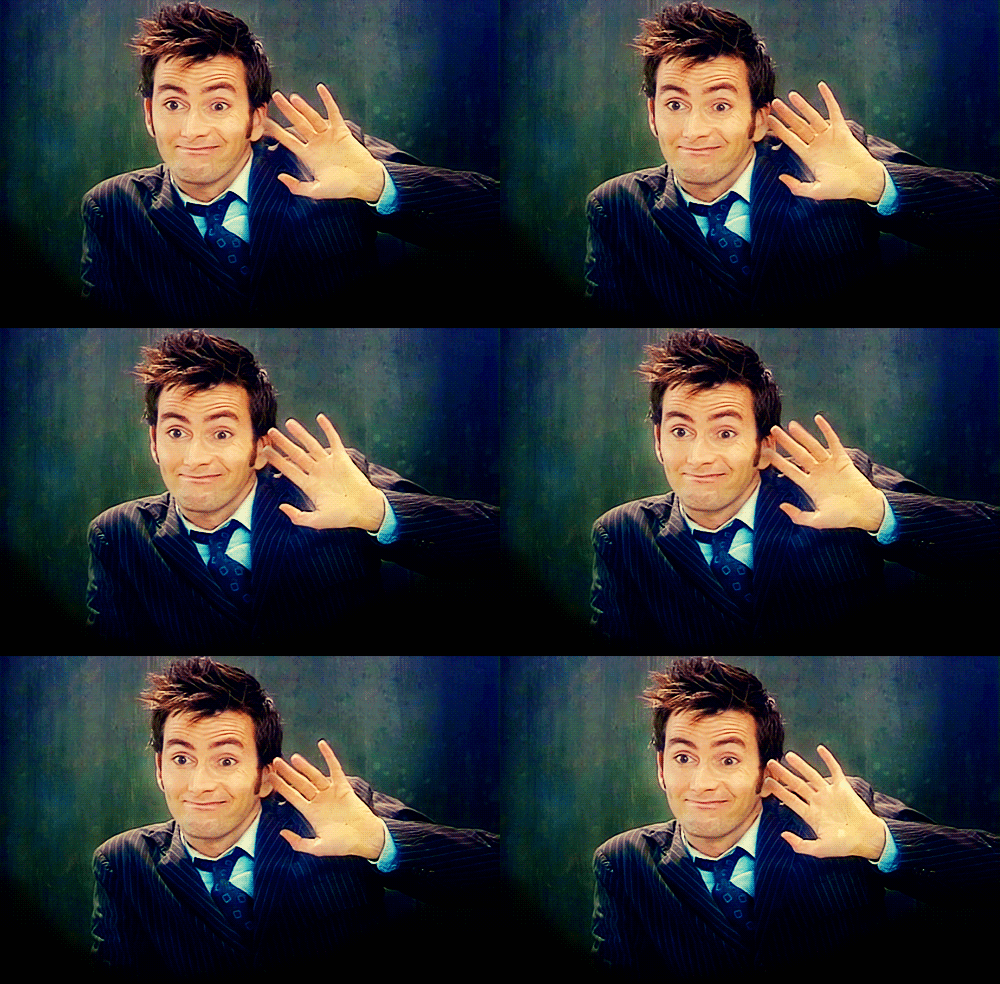
In the clip from Doctor Who, the characters conform to their gender stereotypes, but then the characters reverse roles towards the end, so the weak characters become the stronger ones and the strong become weak, which in some cases means that they stop conforming to the stereotype for their gender.
At the beginning of the clip, Martha behaviour shows that she is conforming to the stereotype that men have dominance and power over women.
When Martha enters the scene, she is in the background, out of focus, while the main focus is on The Master, which gives the impression that she is less important than The Master, her male counterpart.
Martha's clothing is dark and appears to be a military outfit. It is masculine and does not expose her body. Her hair is tied back for practicality. Martha's appearance is not stereotypical of a woman, with the exception of the makeup she is wearing, but even that is unglamourous.
The music playing during the beginning of the scene is dramatic and the bass line is in beat with Martha's steps as she approaches The Master, which connotes that she is walking to her doom and that The Master holds the power to decide her fate.
When Martha looks at her family, the music changes to a higher pitch, to signify that she is happy to see them, then returns to the original pitch when she looks back to The Master, insinuating that she is not happy to see him, possibly because he has power over her so she is afraid.
There are many close ups of Martha, showing how scared she feels and how vulnerable she is.
A medium shot of Martha is used to show her body language; her arms are by her side and her face displays a worried expression- she does not look confident. This shot also allows us to see the two (male) security guards either side of her, holding guns which shows that Martha could be harmed by them if she were to rebel.
A point of view shot shows us Martha looking at her family's scared and worried faces, which denotes that they are concerned for her. This makes us sympathise with Martha as a weaker character in the situation.
Another medium shot and separate a low angle shot of Martha shows her looking up to The Master as he is above her, both in position and hierarchy.
The camera tilts down, following Martha's movement as she kneels down when The Master tells her to. This shows her becoming less and less powerful as she is physically even lower and she is obeying The Master.
A long shot of the whole scene depicts everything that is happening in the room. The Master is giving a speech and Martha is about to be executed. The close ups of Martha begin to reveal that she no longer looks as scared as before, despite what is happening.
We see a close up of Martha as she begins to smile, then we hear her chuckle to herself. This is an indication that something is not right as she is no longer reacting to the situation appropriately. This is supported by the mid shot of her family reacting to her with surprised faces, curious as to why she is not in fear of the man who is pointing a weapon at her.
Notable non-diegetic sound at this point is the change in music, with a lower pitch being introduced, creating the effect of mystery which foreshadows a change in the situation so the audience will want to know what happens next. Then the music picks up in pace and sounds less serious as Martha gradually becomes more powerful and speaks for the first time in the scene.
Martha explains what she had done to get where she is, which is shown through a series of jump cuts to flashbacks. A non-diegetic sound effect is added to show transition from current-time to flashback. In the flashbacks the colour pallet of the images has been altered to make it seem more 'dream-like' and the dialogue is made to sound like it is echoing. In these flashbacks we see that Martha is not conforming to female stereotypes as she is showing how independent she is, how brave she is, and that she is capable of things that could have caused her great physical strain, which is not stereotypical of a woman.
As Martha stands up, the camera follows her, showing her rise against The Master. The music builds up the atmosphere, generating suspense, and the increasing volume and dramatic choir-singing creates the feeling that there is going to be a revelation. The more Martha explains, the more we see through a series of fast-paced cuts between close ups that The Master is now looking increasingly worried while Martha looks to be becoming increasingly confident. This role reversal highlights how Martha had the upper-hand in the situation all along and that she is the dominant character, which contrasts with the idea that men are stronger than or have dominance over women.
The Master starts off as the most dominant character in the scene- the first shot is a close up of him with other characters out of focus in the background who seem less important. A matched cut is used to show him turning to see Martha, so the viewer's eye is absorbed into the atmosphere of the scene.
He is the first person to speak in the clip, and when he does so, he uses prosodic features to assert his dominance over the other characters who are enemies, security guards and people dressed in suits who work for him, and Martha's family who are maids/workers. The volume of his voice is louder than it needs to be for everyone to hear him and his tone of voice makes him sound cocky. He uses interrogatives, declaratives, and exclamations to sound confident.
The background music volume goes down when he speaks, which implies that what he has to say is important, as he is a character that must be listened to.
When The Master talks to Martha, he is patronising, which shows a lack of respect for Martha.
The Master conforms to the male stereotype in that he has dominance over women. He appears to be a typical male; dressed in a black and white suit, short hair and stubble.
We see a long shot of The Master and his partner, Lucy, standing on the platform, which places them above Martha and her family. High angle shots are used to show The Master looking down on Martha because she is below him in rank and in the physical sense.
Close ups of The Master's face are used to indicate that he is self-assured and has total control over the situation. He makes Martha kneel and she does so, proving that he has power over her. We hear him ask another male if the fleet is 'ready to launch', then a jump cut to a long shot CGI of the fleet is shown to indicate how large The Master's army is, and how much power he must have. This editing is repeated with his 'children', and holds the same effect, enforcing the idea that he has a large army, therefore he is unstoppable.
The cutting rhythm is progressively shortened and a graphic match is used to show The Master and Martha facial expressions using close ups as they switch roles and The Master loses his power while Martha regains hers. The ticking noises and close ups of the clock and the use of music to intensify the atmosphere creates a sense of urgency and time running out, which the viewers originally thought was for Martha but then it became clear that time had ran out for The Master as he became a weaker character.
Lucy serves no significant purpose in this scene. She stands to the side of The Master, wearing in a long red dress with a plummeting neckline, revealing her body, her blonde hair curled and her makeup prominent. Her only dialogue is the word 'Doctor' that she says when she betrays The Master, suggesting she is not particularly fond of him. It can only be assumed that she is there for 'The Male Gaze' as her physical appearance is the only thing that makes people take notice of her. She may serve as a 'trophy wife' style character. The red colour of her dress connotes romance, passion, and possibly blood as there would have been a lot of bloodshed if The Master's plan had succeeded. It may serve as foreshadowing. Lucy fits the female stereotype as she is feminine, does not show that she is stronger than any males, and she is dressed in a 'romantic' 'women's' colour.
The Doctor is not a stereotypical male at the beginning of the clip; he is weak and not dominant or masculine. A medium shot is used to show The Doctor in a small cage. He is not very big and he is extremely wrinkled. We see this shot of him for an extended period of time to invoke sympathy from the viewers.
The use of lighting and CGI shows The Doctor as he is restored to his true appearance. The light emitted by The Doctor makes The Master seem dark in comparison, giving an example of Claude Levi-Strauss' 'binary opposition', in this case it is light vs dark/ good vs evil. The Doctor breaks free from his cage and in an over the shoulder shot, we see as he rises into the air, making him higher than The Master, which implies that he now has control over The Master.
We see close ups of The Master's face, showing scared and helpless expressions. He tries to shoot The Doctor with his laser screwdriver but fails as The Doctor is now invincible.
A wind machine blows the characters and some papers around the room, showing the amount of power The Doctor now has. He is now a stereotypical male again- in hierarchy and appearance.
Despite being the true hero in the story, Martha's hard work is forgotten as the focus returns to the main (male) character once more as he approaches The Master.
The Master then backs away and becomes extremely emotional (a stereotype of a woman), before lowering himself onto the floor as The Doctor approaches in all his glowing glory. The Master shouts 'no' repeatedly and we see a high angle shot, looking down on him from The Doctor's point of view.
The character whom was the strongest at the beginning of the clip is now the weakest, and all of the weaker characters have had their original ranks returned to them. The Doctor and Martha have now returned to their stereotypes.
When Martha enters the scene, she is in the background, out of focus, while the main focus is on The Master, which gives the impression that she is less important than The Master, her male counterpart.
Martha's clothing is dark and appears to be a military outfit. It is masculine and does not expose her body. Her hair is tied back for practicality. Martha's appearance is not stereotypical of a woman, with the exception of the makeup she is wearing, but even that is unglamourous.
The music playing during the beginning of the scene is dramatic and the bass line is in beat with Martha's steps as she approaches The Master, which connotes that she is walking to her doom and that The Master holds the power to decide her fate.
When Martha looks at her family, the music changes to a higher pitch, to signify that she is happy to see them, then returns to the original pitch when she looks back to The Master, insinuating that she is not happy to see him, possibly because he has power over her so she is afraid.
There are many close ups of Martha, showing how scared she feels and how vulnerable she is.
A medium shot of Martha is used to show her body language; her arms are by her side and her face displays a worried expression- she does not look confident. This shot also allows us to see the two (male) security guards either side of her, holding guns which shows that Martha could be harmed by them if she were to rebel.
A point of view shot shows us Martha looking at her family's scared and worried faces, which denotes that they are concerned for her. This makes us sympathise with Martha as a weaker character in the situation.
Another medium shot and separate a low angle shot of Martha shows her looking up to The Master as he is above her, both in position and hierarchy.
The camera tilts down, following Martha's movement as she kneels down when The Master tells her to. This shows her becoming less and less powerful as she is physically even lower and she is obeying The Master.
A long shot of the whole scene depicts everything that is happening in the room. The Master is giving a speech and Martha is about to be executed. The close ups of Martha begin to reveal that she no longer looks as scared as before, despite what is happening.
We see a close up of Martha as she begins to smile, then we hear her chuckle to herself. This is an indication that something is not right as she is no longer reacting to the situation appropriately. This is supported by the mid shot of her family reacting to her with surprised faces, curious as to why she is not in fear of the man who is pointing a weapon at her.
Notable non-diegetic sound at this point is the change in music, with a lower pitch being introduced, creating the effect of mystery which foreshadows a change in the situation so the audience will want to know what happens next. Then the music picks up in pace and sounds less serious as Martha gradually becomes more powerful and speaks for the first time in the scene.
Martha explains what she had done to get where she is, which is shown through a series of jump cuts to flashbacks. A non-diegetic sound effect is added to show transition from current-time to flashback. In the flashbacks the colour pallet of the images has been altered to make it seem more 'dream-like' and the dialogue is made to sound like it is echoing. In these flashbacks we see that Martha is not conforming to female stereotypes as she is showing how independent she is, how brave she is, and that she is capable of things that could have caused her great physical strain, which is not stereotypical of a woman.
As Martha stands up, the camera follows her, showing her rise against The Master. The music builds up the atmosphere, generating suspense, and the increasing volume and dramatic choir-singing creates the feeling that there is going to be a revelation. The more Martha explains, the more we see through a series of fast-paced cuts between close ups that The Master is now looking increasingly worried while Martha looks to be becoming increasingly confident. This role reversal highlights how Martha had the upper-hand in the situation all along and that she is the dominant character, which contrasts with the idea that men are stronger than or have dominance over women.
The Master starts off as the most dominant character in the scene- the first shot is a close up of him with other characters out of focus in the background who seem less important. A matched cut is used to show him turning to see Martha, so the viewer's eye is absorbed into the atmosphere of the scene.
He is the first person to speak in the clip, and when he does so, he uses prosodic features to assert his dominance over the other characters who are enemies, security guards and people dressed in suits who work for him, and Martha's family who are maids/workers. The volume of his voice is louder than it needs to be for everyone to hear him and his tone of voice makes him sound cocky. He uses interrogatives, declaratives, and exclamations to sound confident.
The background music volume goes down when he speaks, which implies that what he has to say is important, as he is a character that must be listened to.
When The Master talks to Martha, he is patronising, which shows a lack of respect for Martha.
The Master conforms to the male stereotype in that he has dominance over women. He appears to be a typical male; dressed in a black and white suit, short hair and stubble.
We see a long shot of The Master and his partner, Lucy, standing on the platform, which places them above Martha and her family. High angle shots are used to show The Master looking down on Martha because she is below him in rank and in the physical sense.
Close ups of The Master's face are used to indicate that he is self-assured and has total control over the situation. He makes Martha kneel and she does so, proving that he has power over her. We hear him ask another male if the fleet is 'ready to launch', then a jump cut to a long shot CGI of the fleet is shown to indicate how large The Master's army is, and how much power he must have. This editing is repeated with his 'children', and holds the same effect, enforcing the idea that he has a large army, therefore he is unstoppable.
The cutting rhythm is progressively shortened and a graphic match is used to show The Master and Martha facial expressions using close ups as they switch roles and The Master loses his power while Martha regains hers. The ticking noises and close ups of the clock and the use of music to intensify the atmosphere creates a sense of urgency and time running out, which the viewers originally thought was for Martha but then it became clear that time had ran out for The Master as he became a weaker character.
Lucy serves no significant purpose in this scene. She stands to the side of The Master, wearing in a long red dress with a plummeting neckline, revealing her body, her blonde hair curled and her makeup prominent. Her only dialogue is the word 'Doctor' that she says when she betrays The Master, suggesting she is not particularly fond of him. It can only be assumed that she is there for 'The Male Gaze' as her physical appearance is the only thing that makes people take notice of her. She may serve as a 'trophy wife' style character. The red colour of her dress connotes romance, passion, and possibly blood as there would have been a lot of bloodshed if The Master's plan had succeeded. It may serve as foreshadowing. Lucy fits the female stereotype as she is feminine, does not show that she is stronger than any males, and she is dressed in a 'romantic' 'women's' colour.
The Doctor is not a stereotypical male at the beginning of the clip; he is weak and not dominant or masculine. A medium shot is used to show The Doctor in a small cage. He is not very big and he is extremely wrinkled. We see this shot of him for an extended period of time to invoke sympathy from the viewers.
The use of lighting and CGI shows The Doctor as he is restored to his true appearance. The light emitted by The Doctor makes The Master seem dark in comparison, giving an example of Claude Levi-Strauss' 'binary opposition', in this case it is light vs dark/ good vs evil. The Doctor breaks free from his cage and in an over the shoulder shot, we see as he rises into the air, making him higher than The Master, which implies that he now has control over The Master.
We see close ups of The Master's face, showing scared and helpless expressions. He tries to shoot The Doctor with his laser screwdriver but fails as The Doctor is now invincible.
A wind machine blows the characters and some papers around the room, showing the amount of power The Doctor now has. He is now a stereotypical male again- in hierarchy and appearance.
Despite being the true hero in the story, Martha's hard work is forgotten as the focus returns to the main (male) character once more as he approaches The Master.
The Master then backs away and becomes extremely emotional (a stereotype of a woman), before lowering himself onto the floor as The Doctor approaches in all his glowing glory. The Master shouts 'no' repeatedly and we see a high angle shot, looking down on him from The Doctor's point of view.
The character whom was the strongest at the beginning of the clip is now the weakest, and all of the weaker characters have had their original ranks returned to them. The Doctor and Martha have now returned to their stereotypes.
Wednesday, 6 November 2013
The Male Gaze
1. Chocolate Box: half or full-smile, lips together or slightly parted, teeth barely visible, full or three-quarter face to camera. Projected mood: blandly pleasing, warm bath warmth, where uniformity of features in their smooth perfection is devoid of uniqueness or of individuality.
2. Invitational: emphasis on the eyes, mouth shut or with only a hint of a smile, head to one side or looking back to camera. Projected mood: suggestive of mischief or mystery, the hint of contact potential rather than sexual promise, the cover equivalent of advertising’s soft sell.

3. Super-smiler: full face, wide open toothy smile, head thrust forward or chin thrown back, hair often wind-blown. Projected mood: aggressive, ‘look-at-me’ demanding, the hard sell, ‘big come-on’ approach.

4. Romantic or Sexual: a fourth and more general classification devised to include male and female ‘two-somes’; or the dreamy, heavy-lidded, unsmiling big-heads, or the overtly sensual or sexual. Projected moods: possible ‘available’ and definitely ‘available’.
First in the clip, we see the chocolate box look as Rosie Huntington-Whiteley reacts to the scene around her.
We then see a feature of the Male Gaze as the camera lingers on the curves of her body. The romantic/sexual look is shown next, which is inappropriate in the given context; her expression should show how cold she is more than it does, suggesting the look is added just for the entertainment of males.
We see her direct the invitational look at the male character so the audience can identify with the him.
The last look is the super smiler, used to show the audience that she is happy, persuading them to buy clothes from M&S with the idea that the clothes will make them as happy as she is.
Monday, 4 November 2013
Essay- Hotel Babylon
In the clip From Hotel Babylon we see ethnicity presented through the less positive stereotypes for each characters' ethnicity. Most of the characters of a foreign ethnic background have been portrayed as having less power than their white-British counterparts, working lower paid jobs as cleaners or kitchen workers. All of the police officers that participate in the raid of the building are white-British characters that hunt down the illegal immigrants, which enforces the idea that they are superior to people of other ethnic backgrounds.
The music throughout the clip is upbeat and has a fast tempo, suggesting a chase or pressure will be present during it.
At the beginning of the clip, the focus is on the arrival of the all white-British immigration service that have come to take away the illegal immigrant workers. A mid shot is used when the police officers enter the hotel through the door to show their arrival into the scene as they become the subject. The next image is a mid shot of the hotel receptionist noticing their entrance, which then switches to a close up of the main officer's face, showing his stern expression, which suggests that he is not going to take any nonsense of anyone and he means business.
Atmosphere is created through the movement of the officers as they walk toward the camera, which indicates that they are coming for the illegal immigrants and they are also walking towards the audience, making the scene feel more suspenseful.
Once the main officer has reached the front desk, he verbally claims his authority to search the premises, informing the viewer that he has the most power in this situation and that he is to be feared by the illegal workers.
Two hotel workers rush to inform 'Jackie' about the arrival of the police. A mid shot of Jackie working in her 'office' highlights the conditions that she works in, contrasting with her white counterpart, the receptionist. Jackie's office is below ground and is dark and dingy, and her clothes are black and red, which connotes 'hell'. Upstairs the white-British woman works in a modern and attractive setting that is above the ground and she is dressed in white, giving the connotations of 'heaven'. This suggests that while the hotel looks charming and innocent on the surface, within the hotel there are many dark secrets hidden away, with those secrets being the illegal immigrants. This also shows that the white woman has the better job, whilst Jackie, an Asian woman, has a lower rank than her.
Following pan is used to follow the action of the scene as Jackie runs into the kitchen to round up all of the illegal employees so that she can hide them from the officers. She is shouting in a foreign language, which is something that, stereotypically, people from different ethnic backgrounds do.
The paralinguistic features used in the kitchen scene creating tension e.g. Jackie's and the worker's facial expressions and frantic movements.
As the illegal workers run to a store cupboard to hide in, a close up of Jackie's hand shaking while attempting to unlock the door is shown to present how nervous she is to the audience.
The workers running into the cupboard is shown with blurred 'bars' in the foreground, creating the idea that they are trapped in these furtive lives that only ethnic minorities are subjected to.
When everyone is inside of the storage space, Jackie locks the door. This symbolises that they are now safe, but also being restricted and possibly victimised by society.
There is low lighting in the cupboard, with the lack of light adding to the idea that these illegal immigrants are being kept in the dark, in both senses of the phrase.
The diegetic sounds inside the cupboard consist of the heavy breathing and whimpers of the workers. This is not a situation that any person should find themselves in, which indicates how dehumanised these ethnic minority characters have become. The sounds also convey the stress within the scene and make the show more realistic.
With the exception of Jackie, all of the workers are dressed in uniforms typical of people on a low wage, again indicating that there is an inequality between these characters and white-British ones.
Close ups of all of the illegal employees faces are given to present their emotions; anxious and panicked. Despite the illegal immigrants being of various different ethnic backgrounds, they have conflated, giving them one identity as 'the immigrants', instead of individual people that have their own lives and personalities, which is emphasised when we find out that one of the workers 'Adam', "wasn't always a cleaner" when he uses his medical knowledge to help a worker who fainted under the pressure.
The camera zooms in on Jackie's face to show her reaction to one of the workers being absent from the hiding place, which is followed by parallel editing used to reveal the missing character 'Ebrahim' as he peacefully vacuums a hallway, oblivious to the raid.
As soon as Ebrahim (an African man) sees the officers, he gasps, showing his shock, then attempts to run but trips and falls, where the two officers in suits take get hold of him and begin to take him away.
The camera moves down to the vacuum cleaner that Ebrahim was using not even 30 seconds ago to show that he is gone now and will vacuum the halls no more.
The upbeat music stops when Jackie is informed that an illegal worker has been caught. We then see Ebrahim struggling to escape the grasp of the officers unsuccessfully as they take him outside. This makes the mood more realistic, therefore more emotional so that the audience connects with how Ebrahim and Jackie (who was responsible for the illegal immigrants) feel at that time.
Stereotypes for gender
Males
- Physically strong
- Dominant
- Jobs in construction
- Love for cars/tools
- Masculine
- Clothing- jeans, trainers
- Breadwinner
- Better pay
- Associated with darker colours e.g. blue
Females
- Weaker than men
- Feminine
- Work less manual jobs
- Love for cosmetics/shopping
- Emotional
- Housewives
- Romantic
- Associated with lighter colours e.g . pink
Subscribe to:
Posts (Atom)